Cairo tessellations
Cairo tessellations.
Version of Sunday 21 June 2026.
Dave Barber's other pages.
§ 1. This report proposes a system of assigning index numbers to the pentagons of a
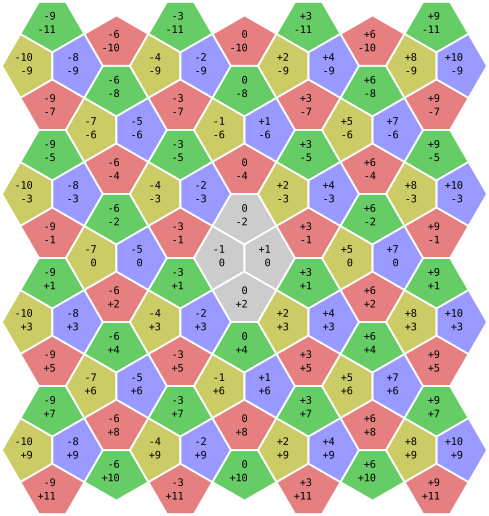
Cairo tessellation, as shown in figure 1:
| figure 1 |
|---|
 |
Within each pentagon:
- The upper number is the x index, roughly corresponding to the abscissa in Cartesian coordinates.
- The lower number is the y index, roughly corresponding to the ordinate. Observe that the y indices increase from top to bottom. This is the usual practice in computer graphics, rather than from bottom to top, as found in most mathematical treatments.
Four pentagons are highlighted to suggest the origin of the indexing system. Because these pentagons point four different directions, it is difficult to find a way to select one pentagon to serve as origin, and to simultaneously maintain a symmetry of index numbers throughout the figure.
Some key characteristics of this system are:
- If two pentagons have the same x index, then they align vertically. The converse is also true.
- If two pentagons have the same y index, then they align horizontally. The converse is also true.
- The tradeoff is that most x-y index combinations cannot be used.
Two pentagons that align might still point opposite directions, for example (+3, +1) and (+3, +5).
There are many different pentagons, varying in the magnitudes of their angles and the lengths of their sides, that will form a Cairo tessellation. The choice in figure 1 was arbitrary, selected to make the structure as clear as possible.
§ 2. The system is based on modulo-6 arithmetic. Figure 2 is an extract from figure 1, with the indices replaced by their moduli. The periodicity is conspicuous:
| figure 2 |
|---|
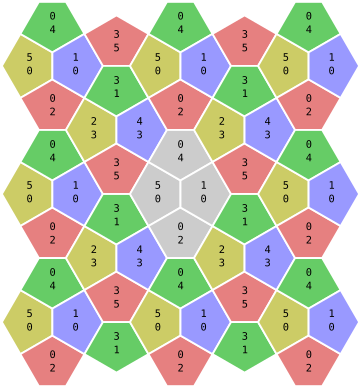 |
Table 1 is a summary of the x-y index pairs:
| table 1 |
|---|
| x mod 6 | y mod 6 | pointing | comment |
| 0 | 2 |
up |
sum of
x and y
is even |
| 3 | 5 |
| 0 | 4 |
down |
| 3 | 1 |
| 1 | 0 |
right |
sum of
x and y
is odd |
| 4 | 3 |
| 2 | 3 |
left |
| 5 | 0 |
| all others are invalid |
|
Because 2 is a factor of 6, it still makes sense to talk about even and odd numbers. If two pentagons point the same direction, their indices are equal in modulo 3.
Table 2 is a reformatting of table 1:
| table 2 |
x mod 6 |
| 0 |
1 |
2 |
3 |
4 |
5 |
y
mod6 |
0 |
– |
right |
– |
– |
– |
left |
| 1 |
– |
– |
– |
down |
– |
– |
| 2 |
up |
– |
– |
– |
– |
– |
| 3 |
– |
– |
left |
– |
right |
– |
| 4 |
down |
– |
– |
– |
– |
– |
| 5 |
– |
– |
– |
up |
– |
– |
Note that only 8 of the 36 possible pairs are eligible.
Precisely whenever (x, y) is a valid index pair, so are these:
| (x ± 6, y) |
|
(−x, y) |
|
(y, x ± 3) |
| (x, y ± 6) |
|
(x, −y) |
|
(y ± 3, x) |
Often, the memberwise sum of two valid (x, y) pairs is NOT valid. More broadly, it is difficult to find an interesting operation that takes two or more valid (x, y) pairs as input and delivers one pair as output.
§ 3. When four pentagons meet at a point, their indices are one of these four modulo-6 combinations:
| table 3 |
|---|
| { (0, 4), (5, 0), (3, 5), (4, 3) } | pointing clockwise |
| { (0, 2), (1, 0), (3, 1), (2, 3) } |
| { (0, 2), (5, 0), (3, 1), (4, 3) } | pointing counter-clockwise |
| { (1, 0), (3, 5), (2, 3), (0, 4) } |
When three pentagons meet at a point, their indices are one of these eight modulo-6 combinations:
| table 4 |
|---|
| { (3, 1), (2, 3), (4, 3) } | none pointing up |
| { (0, 4), (5, 0), (1, 0) } |
| { (0, 2), (1, 0), (5, 0) } | none pointing down |
| { (3, 5), (4, 3), (2, 3) } |
| { (5, 0), (3, 5), (3, 1) } | none pointing right |
| { (2, 3), (0, 2), (0, 4) } |
| { (4, 3), (0, 4), (0, 2) } | none pointing left |
| { (1, 0), (3, 1), (3, 5) } |
§ 4. The transformation x′ = 2x − 3, y′ = 2y + 3 will generate (x′, y′) indices that move the origin to the crossroads where four pentagons meet, but with the inconvenience that all indices will be odd numbers. Additionally, all the comments above about modulo 6 will need to be reconsidered.