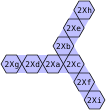
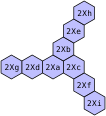
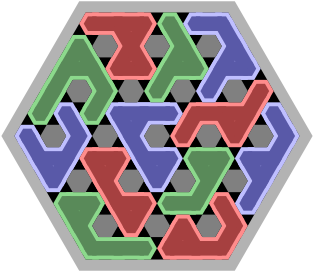
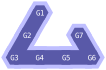
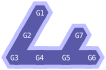
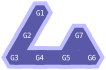
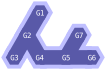
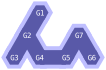
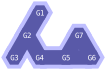
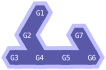
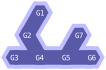
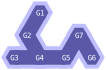
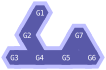
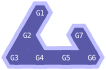
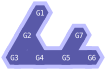
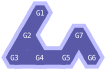
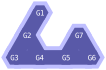
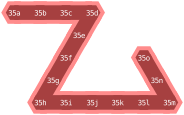
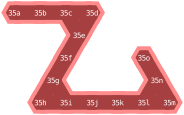
Comparing tile 44 with tile 46, or tile 45 with tile 47, it can be seen that altering one angle changes the tile between working and not working. For some tiles, however, changing an angle does not affect whether it will work. An example of this is found with tiles 28 and 29, shown in figure 2B above: both tiles work.
|
Key Observation
• Each IQH-style tile corresponds to exactly one polyhex.
• Each polyhex might correspond to no IQH-style tile, exactly one tile, or a larger number.
|
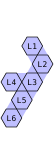
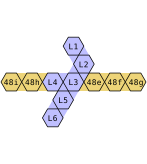
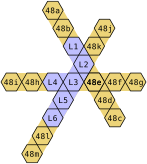
§4B: Eligible. Wherever a valid tile has two adjacent hexagons, the line defined by their centers can be extended arbitrarily far in both directions to produce a larger valid tile. Figure 4d offers an example based on factory tile L1 and various parts of invented tile 48:
| |
figure 4d |
tile L → tile 48
will work |
 |
 |
 |
 |
 |
| |
original |
extending L1-L2 |
extending L3-L4 |
extending L5-L6 (which
incorporates L2-L3) |
extending all |
Tile pairs L4-L5, L1-48k, and 48d-48f can generate further extensions. This procedure is greatly extended in §5 below.
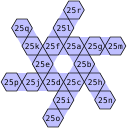
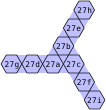
Here are two examples of extensions from tiles defined earlier:
| |
figure 4e extract from figure 2b |
tile 22 → tile 25
and
tile 23 → tile 27
will work |
 |
 |
 |
 |
Going the other way, removing hexagons from a valid tile results in a valid tile, if the remaining hexagons remain connected:
| |
figure 4f extract from figure 2b |
tile 24 → tile 28
will work |
 |
 |
Adding or removing hexagons will often change the number of a tile's orientations.
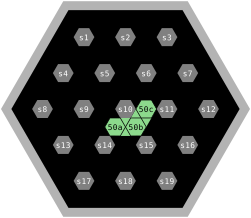
§5: Sufficiency. The method of figure 4d, applied enough times, is sufficient to fill the entire board. From that, the method of figure 4f can be used to remove any undesired tiles. Together, they allow any valid tile to be constructed. We have produced an example of covering the standard IQH board in eighteen steps, but because of its length it is detailed on a page of its own. However, as a glimpse into the procedure, here are the start and finish:
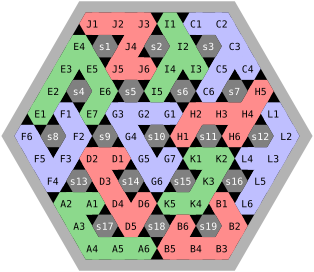
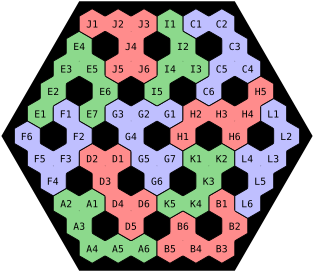
§6: Board sizes and shapes. There are no particular constraints on the size or shape of the board. Figures 6a-b-c-d contain a few examples of what can be done by extending or reducing the factory pattern of studs and tilable hexagons.
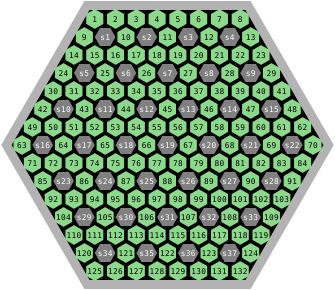
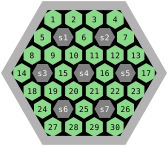
Recall that each tile can be converted into a polyhex, as in the sequence of figure 1. When a valid tile is correctly placed into any of the boards below, each of the polyhex's component hexagons will fit onto one of the numbered green tilables. Meanwhile, the gray hexagons are the usual studs, as in figure 1.
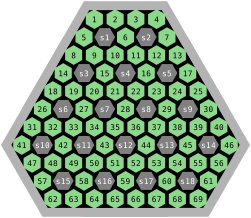
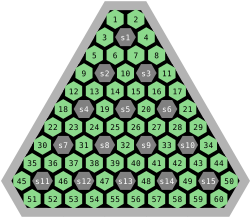
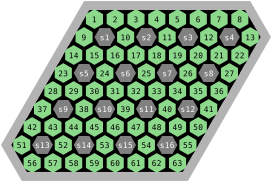
The numbering of the tilables shows what total size of tiles will be necessary for a solution. Note that, from one board size/shape to another, the various totals do not have a common divisor. For instance, figure 6b1 contains 69 = 3 × 23 hexagons, while figure 6b3 contains 74 = 2 × 37 hexagons. There is no simple general formula for calculating the number of hexagons in a board, but there is a convenient formula that will handle many cases.
Figure 6a displays several regular hexagons.
| figure 6a1 — minimal |
figure 6a3 — factory |
figure 6a4 |
 |
 |
 |
| figure 6a2 |
 |
The overall shape need not be a regular hexagon. In particular, the shape of figure 6b3 may be convenient for a player who is resting the board on their lap.
| figure 6b1 | figure 6b2 | figure 6b3 |
 |
 |
 |
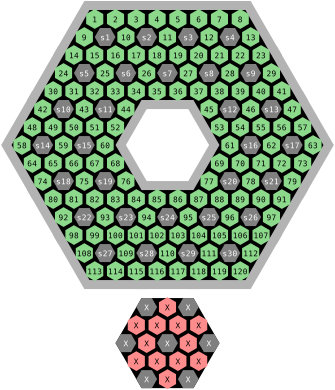
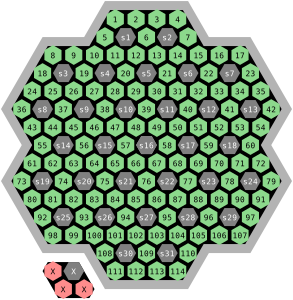
Figures 6c1 and 6c2 are the same approximate rhombus, except differing in their treatment of the acute corners. Figures 6c3 and 6c4 are derived from figure 6a4 by removing sections, revealing that the board can have a hole, and that it need not be convex.
| figure 6c1 | figure 6c3 | figure 6c4 |
 |
 |
 |
| figure 6c2 |
 |
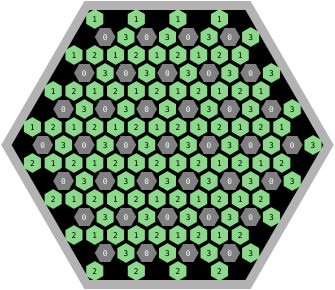
Figure 6d1 shows that, except for edge effects, the number of tilable hexagons is three times the number of studs. Each of the characters "0", "1", "2", and "3" appears 37 times, in one-to-one correspondences:
- each "0" has a "1" to its northwest, and each "1" has a "0" to its southeast;
- each "0" has a "2" to its southwest, and each "2" has a "0" to its northeast;
- each "0" has a "3" to its east, and each "3" has a "0" to its west.
| figure 6d1 |
figure 6d2 |
 |
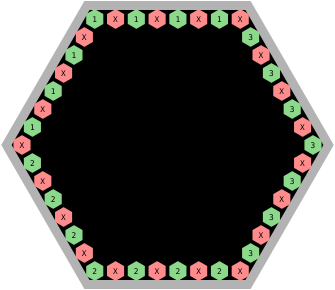 |
Figure 6d2 demonstrates that along the periphery of the board, the hexagons that have been removed (red with X) alternate with those that remain (green with number).
§7: Tessellation.
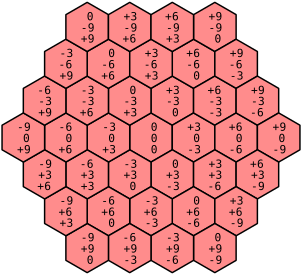
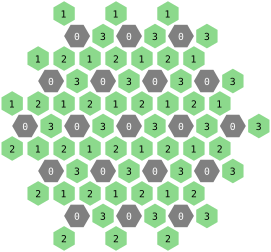
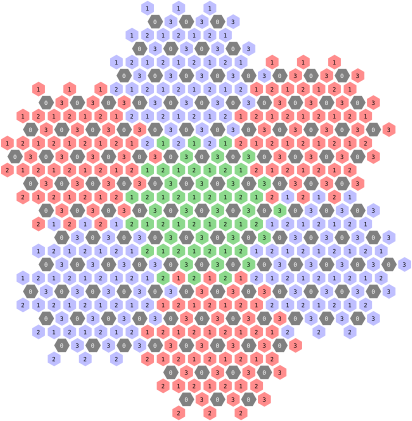
Figure 7a is based on the factory version of IQH, except that the board is not drawn, and some of the tilable hexagons along the edge have been removed to prepare it for tessellation. However, all nineteen studs remain. It corresponds to figure 6d1, differing only in size.
Figure 7b demonstrates the tessellability of figure 7a, with adjacent instances in different colors. If this were the ultimate extent of the board, the gaps at the edges would presumably be filled in.
| figure 7a |
|---|
 |
|
| figure 7b |
|---|
 |
|
The board in figure 6d1 is tessellable in the same manner as 7a into 7b, but requires an unwieldily large image to convey that fact.
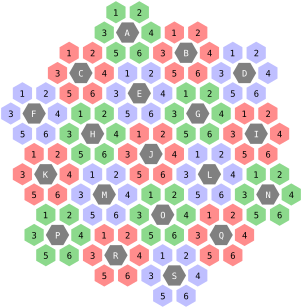
Below, figure 7c shows the pattern of figure 6a1, which can be tessellated (figure 7d) without removing any of the edge hexagons. Although 7c is achiral (except for the numbers), its tessellation in 7d is chiral.
| figure 7c |
|---|
 |
|
| figure 7d |
|---|
 |
|
§8: Non-factory stud patterns. Boards with the factory pattern of studs have a ratio of three tilable hexagons for every stud, except at the edges, as pointed out in the discussion of figure 6d1. However, there are many other possibilities, often related by transforming one pattern into another.
Examples are given below, where most images contain an arbitrary, but convenient rectangular subset of a pattern that can be extended as far as desired. The studs are numbered when it will aid understanding.
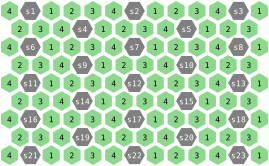
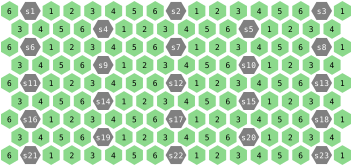
§8A: Expansion and compression. Figure 8a1 has a ratio of two tilables per stud, which is the minimum ratio in an arrangement where no studs are adjacent. Figures 8a2 and 8a3 result from adding tilable hexagons to expand the figure horizontally. Expansion and its opposite, compression, can be applied to many patterns.
| figure 8a1 — ratio 2:1 |
figure 8a2 — ratio 4:1 |
figure 8a3 — ratio 6:1 |
 |
 |
 |
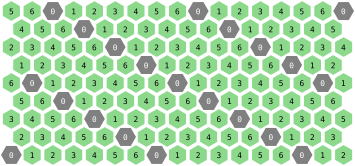
§8B: Shifting. The patterns of figures 8b1 and 8b2 are like that of 8a3, except that rows have been shifted:
- in 8a3, each stud is directly under tilables numbered 3 and 4;
- in 8b1, each stud is under 2 and 3;
- in 8b2, each stud is under 1 and 2.
One more shift would cause the studs to be adjacent in long lines. Although valid, this would lead to a puzzle that many people might find uninteresting.
Shifting so that each stud is under 4 and 5 would give the reflection of 8b1; under 5 and 6, 8b2.
| figure 8b1 — ratio 6:1 |
figure 8b2 — ratio 6:1 |
 |
 |
§8C: Substitution.
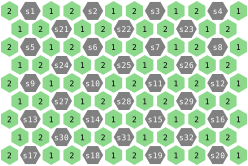
- The pattern of figure 8c1 is the same as that of 8a1, although shown with more horizontal iterations. Studs 21 through 32 form a rectangular grid of their own, which, although smaller, is of the same nature as the grid of studs 1 through 20.
- If studs 21 through 32 are replaced with tilables, figure 8c2 results, with a 5:1 ratio of tilables to studs.
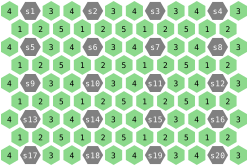
- Figure 8c2 may then be compressed to produce figure 8c3 which has a 3:1 ratio, but which is not the factory pattern. However, the factory pattern can be obtained by shifting studs 5-6-7-8 and 13-14-15-16 by one hexagon horizontally.
| figure 8c1 — ratio 2:1 |
figure 8c2 — ratio 5:1 |
figure 8c3 — ratio 3:1 |
 |
 |
 |
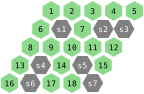
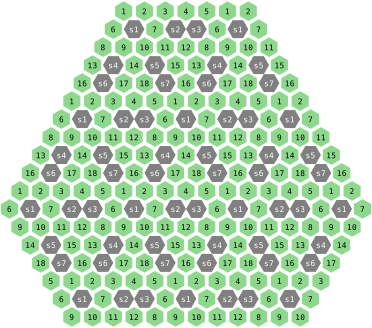
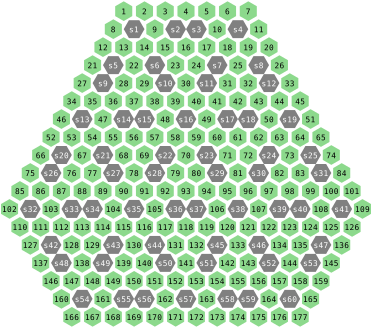
§8D: Multiple adjacent studs. This is not a transformation method, but rather the lifting of a restriction. The pattern shown in figure 8d is best explained by showing a tessellable unit (8d1) and a sample board (8d2). Figure 8d3 is like 8d2, except that the tilables and studs are numbered straight through.
figure 8d1 —
ratio 18:7 ≈ 2.571 |
 |
|
| figure 8d2 |
figure 8d3 |
 |
 |
|
In general, patterns that use multiple adjacent studs will need to be large in order to make the repetition of the pattern obvious. Of course, the transformation methods of §8A-B-C can also be applied here.
§4 above shows several tiles (41-47) that will, or will not, work in the factory stud arrangement; and tile 48 is used to illustrate an extension procedure that will work. However, attempting to place any of these tiles on non-factory stud arrangements may yield different degress of success.
Widely available are polyhex-based puzzles with no studs or other obstructions at all, and they typically include tiles whose polyhex structure is explicit. In fact, on the internet are easily found patterns suitable for three-dimensional printers. However, the presence of studs in the IQ Hexagon puzzle lifts it out of the run-of-the-mill, and renders it a much more nuanced challenge. Indeed, we would have had no reason to write this report if the studs had been omitted.
§9: Miscellaneous.
This page was created on a Macintosh computer. We used two components of Apple's Xcode: the text editor for preparing the HTML, and the C++ compiler running our own code for producing the Scalable Vector Graphics (SVG) images.
Because the images are in a vector format rather than a raster format, they can be enlarged or reduced with negligible loss of accuracy. Each of the over 200 images is in a separate file, which the general public is welcome to download, modify, and republish.
The somewhat awkward letter-and-numbering scheme for invented tiles reflects two factors:
- there is room for only three characters for each label within the images;
- it would be confusing to have, for instance, a tile containing the label "2a" or "2A" when there is already a figure named "2a".
This results in the peculiar sequence of tile numbers 51-52-53-54-55-56-57-58-59-5Z-5Y-5X-5W-5V-5U-5T-5S-5R of the
§5 annex.
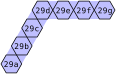
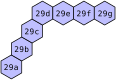
Figure 4a (far above) gives the standard names of three of the seven tetrahexes. Figure 9a (immediately below) gives the other four: