§6 annex: More about board sizes and shapes. This page elaborates on §6 of the home page.
§6X. This page presents a formula to count the number of hexagons on a board when they meet four criteria:
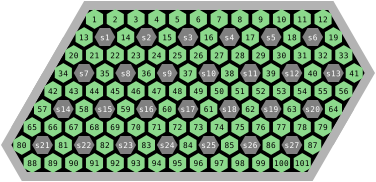
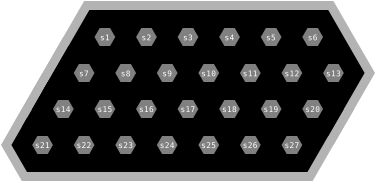
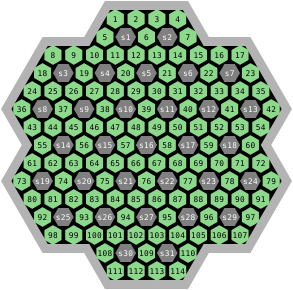
Figure 6e1 is an irregular board not shown on the home page, while figure 6e2 is the same thing, but without the tilable hexagons:
| figure 6e1 | figure 6e2 |
|---|---|
|
|
Because the arrangement of studs can be interpreted as a hexagon (although with one very short edge) the quantities of studs on the six edges can be counted. Working clockwise from the upper left:
| studs | ||
|---|---|---|
| labels | qty | |
| top | s1, s2, s3, s4, s5, s6 | a = 6 |
| upper right | s6, s13 | b = 2 |
| lower right | s13, s20, s27 | c = 3 |
| bottom | s27, s26, s25, s24, s23, s22, s21 | d = 7 |
| lower left | s21 | e = 1 |
| upper left | s21, s14, s7, s1 | f = 4 |
This particular board was selected because every side is of a different length, reducing risk of ambiguity in the explanation.
It so happens that the following equations will automatically be satisfied:
| a + b = d + e | ⇒ | 6 + 2 = 7 + 1 |
| b + c = e + f | ⇒ | 2 + 3 = 1 + 4 |
| c + d = f + a | ⇒ | 3 + 7 = 4 + 6 |
Now define the tri function:
tri (n) = n × (n − 1) ÷ 2
The number of studs s is:
s = tri (b + c + d − 1)
− tri (b) − tri (d) − tri (f)
s = tri (2 + 3 + 7 − 1) − tri (2) − tri (7) − tri (4)
s = 55 − 1 − 21 − 6 = 27
The gross number of hexagons g is:
g = tri (2b + 2c + 2d − 1)
− tri (2b) − tri (2d) − tri (2f)
g = tri (4 + 6 + 14 − 1) − tri (4) − tri (14) − tri (8)
g = 253 − 6 − 91 − 28 = 128
The number of tilable hexagons t is:
t = g − s
t = 128 − 27 = 101
Related topics from the present author:
§6Y. The next five images also appear on the home page.
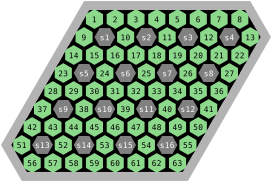
The formula works for figure 6c1 below; but not 6c2, because its tiles 9 and 57 are not adjacent to any stud (criterion 4).
| figure 6c1 | figure 6c2 |
|---|---|
 |
 |
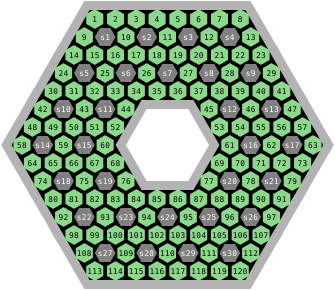
The formula fails for figure 6c3 below because of the hole (criterion 2), and fails for 6c4 because the overall shape of the board is neither convex nor a hexagon (criterion 1).
| figure 6c3 | figure 6c4 |
|---|---|
 |
 |
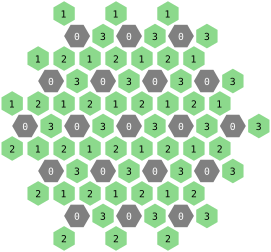
The formula fails for figure 7a because some studs (for example, s3) are not surrounded by six tilable hexagons (criterion 3).
| figure 7a |
|---|
 |